
A superconducting half-dome in bilayer nickelates
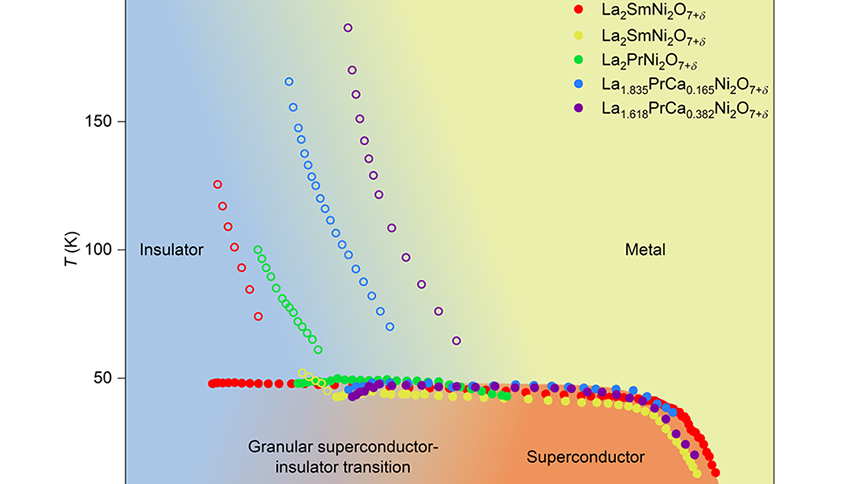
Understanding how superconductivity emerges and collapses in correlated electron systems remains a central challenge in condensed matter physics. As a recently discovered member of the high temperature superconductor family, bilayer nickelates provide a new opportunity for examining this problem. Their pronounced sensitivity to oxygen stoichiometry, while posing challenges for stabilizing superconductivity, simultaneously offers an effective control parameter for tuning electronic phases. Here we report a superconducting half-dome in compressively strained bilayer nickelate thin films as a function of continuous tuning of oxygen stoichiometry. Starting from an optimally superconducting state, increasing oxygen stoichiometry gradually suppresses superconductivity toward a metallic phase, whereas decreasing oxygen stoichiometry drives a granular superconductor-to-insulator transition while leaving the superconducting onset intact. This half-dome structure can be understood to arise from the contrasting roles played by interstitial oxygen versus oxygen vacancies – namely the dominance of doping versus scattering. Notably, the half-dome emerges consistently across samples with different rare-earth combinations, with or without alkaline-earth doping, revealing a general feature of the bilayer nickelate phase diagram.
Read the whole article by Liu et al. on arXiv.