
Enhanced superconductivity in palladium hydrides by non-perturbative electron-phonon effects
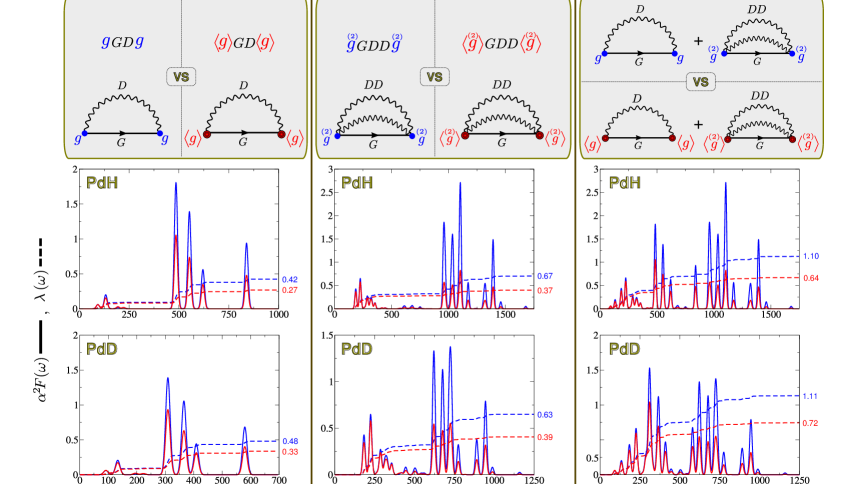
Palladium hydrides exhibit the largest isotope-effect anomaly in superconductivity: replacing hydrogen with heavier isotopes increases the superconducting critical temperature. Although this behavior is commonly attributed to strong anharmonic hydrogen vibrations, \textit{ab initio} treatments have so far incorporated anharmonic effects only through phonon renormalization, neglecting non-linear contributions to the electron-phonon interaction vertices. While such approaches reproduce the anomalous isotope trend, they severely underestimate the critical temperatures. Here, we show that non-linear electron-phonon coupling is essential in palladium hydrides. A straightforward inclusion of higher-order perturbative terms leads to a qualitative breakdown: the critical temperature is overestimated and the isotope anomaly is lost. We therefore adopt a non-perturbative framework based on an explicit evaluation of the ion-mediated electron-electron interaction, enabling anharmonic effects to be treated consistently in both the phonon spectra and the interaction vertices. Applied to PdH and PdD, it restores the anomalous isotope effect and brings calculated critical temperatures into significantly improved agreement with experiments.
Read the whole article by Bianco & Errea on arXiv.