
Observation of an obstructed atomic band in a transition metal dichalcogenide
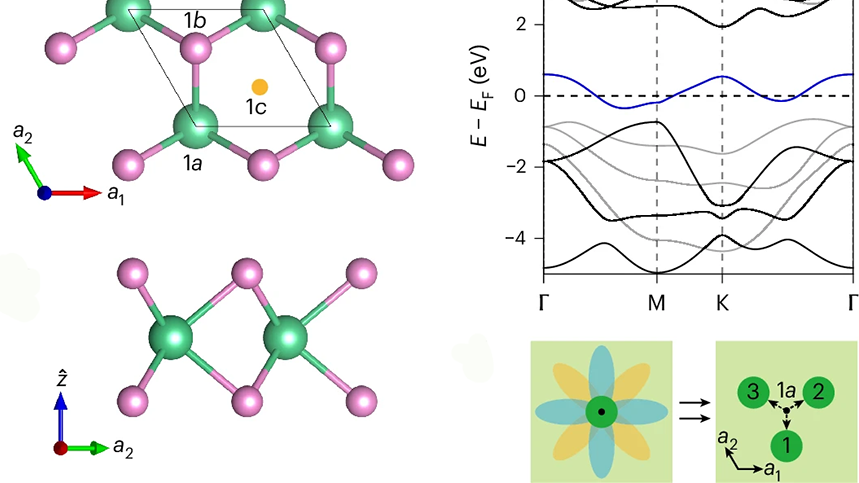
Topologically trivial insulators are classified into two primary categories: unobstructed and obstructed atomic insulators. Although both types can be described by exponentially localized Wannier orbitals, a defining feature of obstructed atomic insulators is that that the centre of charge of at least one of these orbitals is positioned at an empty site within the unit cell, rather than on an occupied atomic site. Despite extensive theoretical predictions, the unambiguous quantitative experimental identification of an obstructed atomic phase has not yet been achieved. Here we present direct evidence of such a phase in 1H-NbSe2. We develop a method to extract the interorbital correlation functions from the local spectral function probed by scanning tunnelling microscopy and using the orbital wavefunctions obtained from ab initio calculations. Applying this technique to real-space spectroscopic images, we determine the interorbital correlation functions for the atomic band of 1H-NbSe2 that crosses the Fermi level. Our results show that this band realizes an optimally compact obstructed atomic phase. This approach is broadly applicable to other material platforms (including related compounds such as 1H-TaSe2 that also feature obstructed atomic bands) and offers a powerful tool for exploring other electronic phases.
Read the whole article by Călugăru et al. in Nature Physics.