
Optical conductivity signatures of strong correlations and multiband superconductivity in infinite-layer nickelates
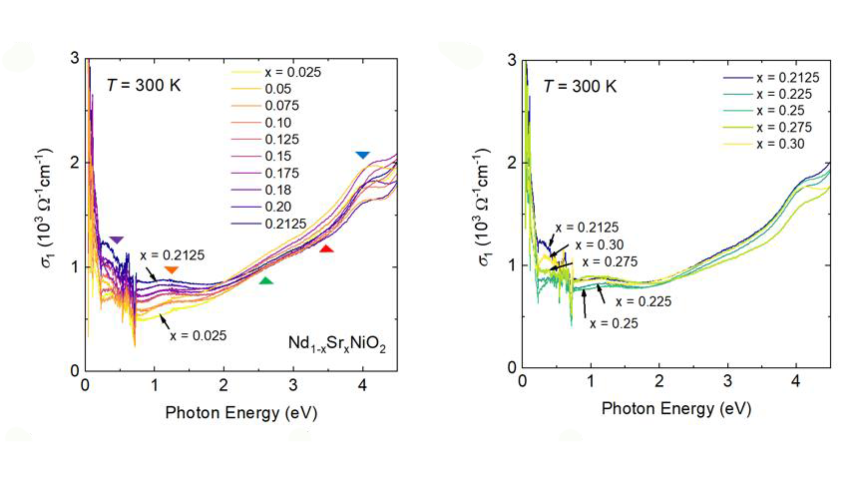
Since the discovery of superconductivity in infinite-layer nickelates, there have been extensive efforts to unravel their electronic structure and pairing mechanism. In particular, understanding how the electronic structure evolves with doping is essential for clarifying theoretical models of superconductivity in nickelates. Here we present studies of the optical conductivity of Nd1-xSrxNiO2 thin films spanning the full phase diagram 0.025 < x < 0.30 using spectroscopic ellipsometry. The data are consistent with a two-band Drude model, which allows the decomposition of the intraband response into distinct contributions. One is from a “narrow” Drude term which we associate with electron bands, and the other a “broad” Drude term linked to the hole band with strong correlations. Increasing Sr doping leads to an expansion of the hole band spectral weight, and a corresponding reduction in the electron band, indicative of the multiband electronic structure and a doping-dependent reconstruction of the Fermi surface. Both doping and temperature-dependent optical spectra display significant spectral weight transfer from high to low energy, a hallmark of strong electronic correlations. In the superconducting state at optimal doping (x = 0.15), both electron and hole bands contribute to the superconducting condensate, signifying multiband superconductivity.
Read the whole article by Kim et al. on arXiv.