
Reducing the Strain Required for Ambient-Pressure Superconductivity in Ruddlesden-Popper Bilayer Nickelates
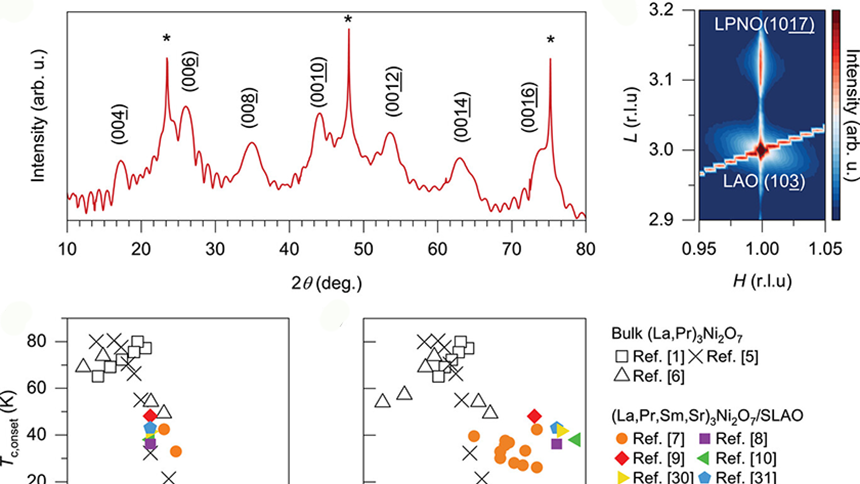
The discovery of high-temperature superconductivity in pressurized bulk Ruddlesden-Popper (RP) bilayer nickelates has prompted the conjecture that epitaxial compressive strain might mimic essential aspects of hydrostatic pressure. The realization of superconductivity in films on SrLaAlO4 (001) (SLAO) supports this correspondence, yet it remains unclear whether the pressure–temperature phase diagram of RP bilayer nickelates can be systematically mapped (and studied at ambient pressure) as a function of epitaxial strain. To this end, experimental access near the elusive edge of the superconducting phase boundary would provide invaluable insight into the nature of the superconducting state and the ground state from which it emerges. Here we report superconducting RP bilayer nickelates grown on LaAlO3 (001) (LAO), where the compressive strain required for ambient-pressure superconductivity is nearly halved to −1.2%. These films exhibit a superconducting onset above 10 K and reach zero resistance at 3 K, with normal-state transport properties differing from those of films grown on SLAO. Our comparative study shows that strain–rather than interfacial structure is the primary factor governing the superconductivity and normal-state properties. This work offers a new opportunity to probe emergent phenomena near the superconducting phase boundary in the strain–temperature phase diagram of RP bilayer nickelates.
Read the whole article by Tarn et al. in Advanced Materials.