
Superconductivity in Electron Liquids: Precision Many-Body Treatment of Coulomb Interaction
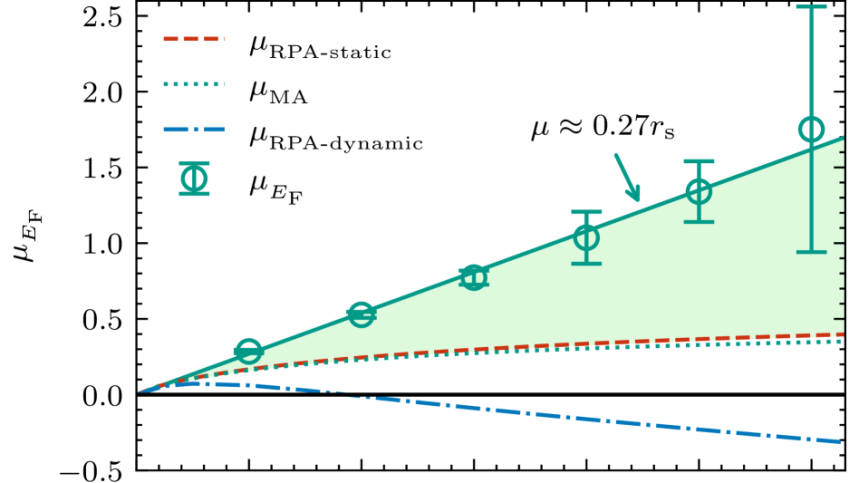
More than a century after discovery, the theory of conventional superconductivity remains incomplete. While the importance of electron-phonon coupling is understood, a controlled first-principles treatment of Coulomb interaction is lacking. Current ab initio calculations of superconductivity rely on a phenomenological downfolding approximation, replacing Coulomb interaction with a repulsive pseudopotential \mu*, and leaving ambiguities in electron-phonon coupling with dynamical Coulomb interactions unresolved. We address this via an effective field theory approach, integrating out high-energy electronic degrees of freedom using variational Diagrammatic Monte Carlo. Applied to the uniform electron gas, this establishes a microscopic procedure to implement downfolding, define the pseudopotential, and express dynamical Coulomb effects on electron-phonon coupling via the electron vertex function. We find the bare pseudopotential significantly larger than conventional values. This yields improved pseudopotential estimates in simple metals and tests density functional perturbation theory accuracy for effective electron-phonon coupling. We present an ab initio workflow computing superconducting Tc from the anomalous vertex’s precursory Cooper flow. This infers Tc from normal state calculations, enabling reliable estimates of very low Tc (including near quantum phase transitions) beyond conventional reach. Validating our approach on simple metals without empirical tuning, we resolve long-standing discrepancies and predict a pressure-induced transition in Al from superconducting to non-superconducting above ~60GPa. We propose ambient-pressure Mg and Na are proximal to a similar critical point. Our work establishes a controlled ab initio framework for electron-phonon superconductivity beyond the weak-correlation limit, paving the way for reliable Tc calculations and novel material design.
Read the whole article by Cai et al. on arXiv.