
Machine-learning-guided discovery of kagome superconductors YRu3B2 and LuRu3B2
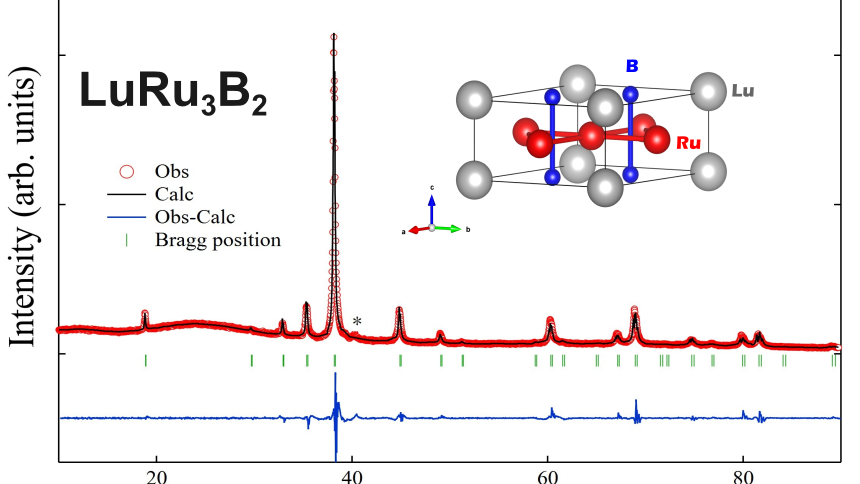
We report the experimental discovery of bulk superconductivity in two kagome lattice compounds, YRu3B2 and LuRu3B2, which were predicted through machine-learning-accelerated high-throughput screening combined with first-principles calculations. These materials crystallize in the hexagonal CeCo3B2-type structure with planar kagome networks formed by Ru atoms. We observe superconducting critical temperatures of 𝑇𝑐=0.81 K for YRu3B2 and 𝑇𝑐=0.95 K for LuRu3B2, confirmed through magnetization, specific heat, and electrical transport measurements. Both compounds exhibit nearly 100% superconducting volume fractions, demonstrating bulk superconductivity. Compared with isostructural LaRu3Si2, YRu3B2 and LuRu3B2 show a more dispersive Ru local 𝑑𝑥2−𝑦2 quasiflat band [and thus a reduced density of states (DOS) at 𝐸𝐹] together with an overall hardening of the phonon spectrum, both of which lower the electron-phonon coupling (EPC) constant 𝜆. Meanwhile, the dominant real-space EPC between Ru local 𝑑𝑥2−𝑦2 states and the low-frequency Ru in-plane local 𝑥 branch remains nearly unchanged, indicating that the reduction of 𝜆 originates from the 𝑑𝑥2−𝑦2 DOS reduction and the overall phonon hardening. Superfluid weight calculations show that conventional contributions dominate over quantum geometric effects due to the dispersive nature of bands near the Fermi level. This work demonstrates the effectiveness of integrating machine-learning screening, first-principles theory, and experimental synthesis for accelerating the discovery of new superconducting materials.
Read the whole article by Mustaf et al. in Physical Review Research