
The impact of ionic anharmonicity on superconductivity in metal-stuffed B-C clathrates
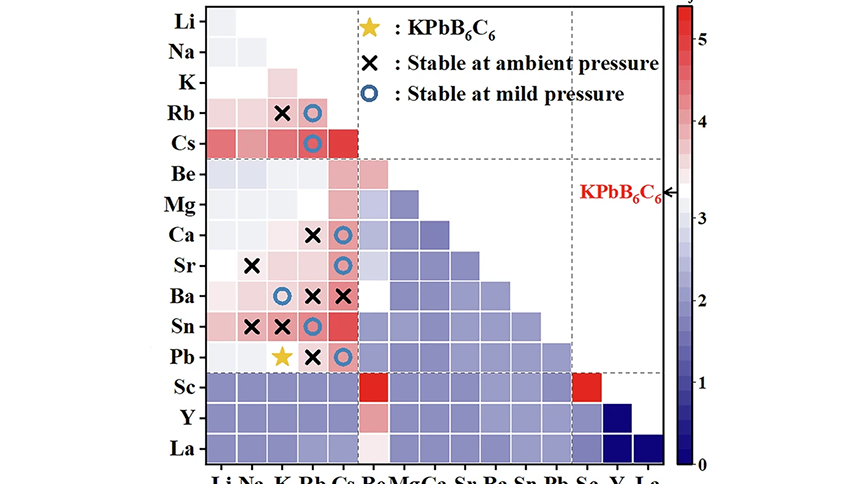
Metal-stuffed B–C compounds with sodalite clathrate structure have captured increasing attention due to their predicted exceptional superconductivity above liquid nitrogen temperature at ambient pressure. However, by neglecting the quantum lattice anharmonicity, the existing studies may result in an incomplete understanding of such a lightweight system. Here, using state-of-the-art ab initio methods incorporating quantum effects and machine learning potentials, we revisit the properties of a series of XYB6C6 clathrates where X and Y are metals. Our findings show that ionic quantum and anharmonic effects can harden the Eg and Eu vibrational modes, enabling the dynamical stability of 15 materials previously considered unstable in the harmonic approximation, including materials with previously unreported (XY)1+ state, which is demonstrated here to be crucial to reach high critical temperatures. Further calculations based on the anisotropic Migdal-Eliashberg equation demonstrate that the Tc values for KRbB6C6 and RbB3C3 among these stabilized compounds are 102 and 115 K at 0 and 15 GPa, respectively, both being higher than Tc of 92 K of KPbB6C6 at the anharmonic level. These record-high Tc values, surpassing liquid nitrogen temperatures, emphasize the importance of anharmonic effects in stabilizing B-C clathrates with large electron-phonon coupling strength and advancing the search for high-Tc superconductivity at (near) ambient pressure.
Read the whole article by Zhao et al. in npj computational materials.