
The role of the apical oxygen in cuprate high-temperature superconductors
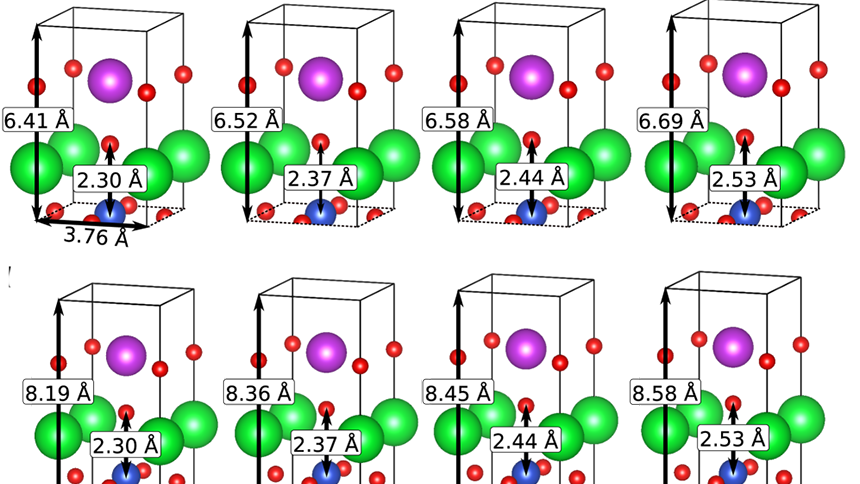
Scanning tunneling microscopy measurements exploiting the natural superstructure modulation of the cuprate superconductor Bi Sr CaCu O (Bi-2212) have revealed a possible correlation between the Cu-apical-O distance and the superconducting order parameter , as reported recently by O’Mahony et al. (Proc. Natl. Acad. Sci. 119, e2207449119 (2022)). These observations were interpreted as evidence for a direct link between superconductivity and the charge-transfer gap, and more broadly revived the long-standing question of the role of apical oxygens in cuprate superconductivity. Using a combination of density-functional theory and cluster dynamical mean-field theory, we compute from first principles the variations of induced solely by apical oxygen displacement in Bi Sr CuO , Bi-2212, and HgBa CuO . The quantitative agreement between our calculations and experiments allows us to unambiguously attribute the observed variations of to changes in . We demonstrate, however, that these variations of originate predominantly from changes in the effective hole-doping of the CuO planes, with negligible effect on the charge-transfer gap. The modest magnitude of the modulation induced by apical-oxygen displacement alone therefore warrants caution in interpreting correlations between and inferred from comparisons across different cuprate compounds.
Read the whole article by Vadnais et al. on arXiv.